Key Points:
- Social communication challenges are one of the core features of autism and can affect speech, gestures, and everyday interactions.
- Recognizing the signs early helps parents and caregivers support meaningful communication growth.
- ABA therapy and evidence-based strategies can help improve communication and social skills for children with autism.
For many parents, one of the first things they notice in their child with autism is difficulty connecting or communicating with others. A child may speak less, avoid eye contact, or seem uninterested in social games or back-and-forth conversation. These experiences can be confusing and even worrying.
Autism social communication is how those in the spectrum use language, gestures, tone, and body language to connect with other people. This process can look very different from what we know. These differences don’t mean a child doesn’t want to connect; they often mean they’re communicating in a way that’s harder for others to recognize.
About 1 in 36 children in the U.S. is diagnosed with autism spectrum disorder (ASD). Social communication differences are part of what defines that diagnosis.
Recognizing the Signs of Autism Communication Difficulties
Every child with autism has their own way of expressing needs and emotions, but certain patterns often appear early. Recognizing these signs helps families seek support and start intervention at the right time.
Common signs of autism communication difficulties include:
- Limited or no use of gestures, such as pointing or waving
- Difficulty making or maintaining eye contact
- Repeating words or phrases (echolalia)
- Challenges understanding tone, humor, or figurative language
- Talking at length about favorite topics without noticing if others are listening
- Trouble starting or maintaining conversations
- Using unusual speech rhythms, pitches, or tones
Some children may use few or no spoken words but communicate effectively through signs, pictures, or technology. Others might have a strong vocabulary but still struggle to use language for social interaction.
Early identification matters because therapy and family support can build stronger communication pathways and social confidence.
Autism Social Communication: Why It’s So Complex
Social communication involves more than words. It includes understanding social cues, recognizing emotions, and responding appropriately to different contexts. For children with autism, each of these steps can pose unique challenges.
Many experience difficulties reading facial expressions or interpreting nonverbal cues like body posture or tone of voice. A conversation that feels simple to most people can feel unpredictable or overwhelming to a child with autism.
This is why children with autism might seem withdrawn or uninterested; they may be unsure how to respond or afraid of making a mistake. These struggles with social interaction in autism can lead to frustration, social anxiety, or isolation if not addressed with understanding and structured support.
Common Struggles with Social Interaction in Autism
Parents often describe seeing their child want to join a group or play but not know how. This can lead to moments where a child stands nearby but doesn’t engage or becomes upset when others don’t follow their play style.
Here are some common struggles families observe:
- Difficulty with reciprocity. Conversations or play often rely on taking turns. Many children with autism find this back-and-forth rhythm challenging.
- Understanding emotions. Identifying how others feel from facial expressions or tone can be confusing.
- Perspective-taking. Understanding another person’s thoughts or intentions takes abstract thinking that may develop differently in autism.
- Sensory factors. Bright lights, loud sounds, or crowded spaces can make social situations overwhelming, causing a child to withdraw.
Addressing these autism communication challenges early helps children build comfort and skills for lifelong interaction and connection.
Practical Solutions for Autism Social Communication
Improving communication in autism requires consistent support at home, in therapy, and in school settings. The right approach depends on a child’s abilities, interests, and environment. Here are evidence-based strategies that make a real difference:
- Use Visual Supports
Many children with autism are strong visual learners. Tools such as picture schedules, social stories, and visual cues can make social situations predictable and easier to follow. - Encourage Joint Attention
Joint attention (sharing focus on an object or event) is a key social skill. Practice by pointing to things, naming them, and celebrating when your child looks or responds. - Model Communication Naturally
Narrate your actions throughout the day (“Now I’m putting on my shoes”) and use simple, clear language. Modeling helps children connect words to meaning. - Teach through Play
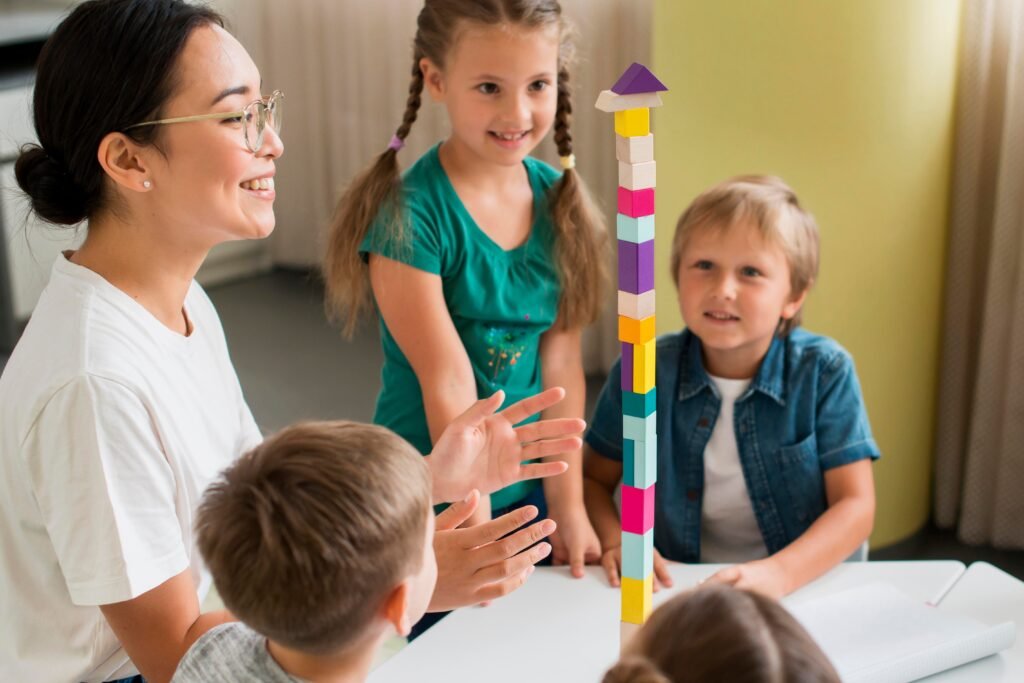
Play builds social and communication skills naturally. Use turn-taking games, pretend play, and role-playing to model conversation and cooperation. - Reinforce Effort and Engagement
Celebrate all attempts at social communication—eye contact, gestures, or simple words. Positive reinforcement encourages more interaction over time. - Collaborate with Therapists
Applied Behavior Analysis (ABA) therapy, speech therapy, and occupational therapy often work hand in hand to address communication barriers. An ABA therapist can help break down complex social behaviors into teachable, rewarding steps. - Create Predictable Routines
Consistency helps children with autism feel secure. When communication happens in predictable ways, learning becomes easier and less stressful.
Improving Communication in Autism at Home
Parents and caregivers play an essential role in fostering growth outside of therapy sessions. Small, consistent efforts each day can strengthen a child’s comfort with interaction.
Try these home-based strategies:
- Build in short, structured social moments, like reading together or sharing snack time.
- Use calm, clear tone and give extra time for your child to respond.
- Encourage communication through multiple forms – spoken words, gestures, or assistive devices.
- Talk about emotions openly. Label your own feelings and point out emotions in others.
- Involve siblings and peers in gentle, guided play to practice social skills in safe settings.
These steps help create a supportive environment where communication feels rewarding rather than stressful.
Social Skills in Autism: What Progress Looks Like
Progress in social skills autism programs can look different for each child. Some children might begin using words more consistently, while others show growth in nonverbal communication like gestures or facial expressions.
Signs of improvement might include:
- Increased initiation of social interaction
- More appropriate eye contact
- Better understanding of social cues
- Reduced frustration during communication
- Growth in confidence during group or peer play
Progress often happens gradually but steadily with the right support, reinforcement, and patience.

Beyond Words: Building Meaningful Connections
While language is a major focus of social communication, relationships are at the heart of it all. Children with autism can form strong, genuine bonds when given time, structure, and understanding.
Parents can nurture connection by showing genuine interest in their child’s preferred activities, following their lead during play, and staying responsive to small communication attempts.
The goal isn’t to change who the child is; it’s to empower them to express themselves and feel understood.
Finding Hope Through Support and ABA Therapy
Families don’t have to navigate autism communication challenges alone. Applied Behavior Analysis (ABA) therapy offers structured, individualized approaches to teaching communication and social skills in a way that fits each child’s learning style.
ABA programs focus on breaking complex skills into achievable steps and using reinforcement to make learning meaningful. Over time, these methods can help children with autism gain confidence in expressing themselves, forming relationships, and participating in the world around them.
Get compassionate support for your family with Glow Forward’s ABA therapy in Maryland and North Carolina. Our team provides personalized care plans designed to strengthen communication, social understanding, and daily living skills for children with autism. Whether your goal is to help your child express themselves, build friendships, or feel more confident in social settings, Glow Forward offers evidence-based support every step of the way.
Contact us today to learn more about our ABA therapy services in Maryland and North Carolina and how we can help your child move forward with confidence and connection.