Key Points:
- In-home ABA therapy teaches daily living skills in the exact spaces where your child needs to use them.
- Children with autism who learn at home show stronger skill generalization than those learning in clinical settings.
- Glow Forward ABA supports families across Charlotte, Raleigh, Durham, Chapel Hill, and the wider North Carolina area with fully individualized programs.

Before ABA therapy even begins, you may have already spent the morning managing transitions, packing comfort items, adjusting schedules, and preparing your child for a change in routine. By the time you reach the appointment, everyone’s energy is running low.
For many children with autism, the effort of getting to therapy can become a challenge of its own. Home-based ABA therapy removes that extra layer and brings support directly into the environment where your child is most comfortable.
Why the Home Setting Matters More Than Parents Expect
When a child learns a new skill in a clinic, it does not automatically travel home with them. This is one of the biggest challenges families face when they start ABA therapy for the first time. A child can demonstrate a skill perfectly in a structured therapy room and still struggle to apply it at the breakfast table.
In-home ABA therapy closes that gap. When autism skill-building happens in the kitchen, the bathroom, the playroom, or during the school-morning rush, the learning is tied to the context where it needs to happen. Generalization improves because the child practices in their natural environment.
For families looking for North Carolina ABA programs that deliver measurable results, this is a meaningful distinction.
Who Is In-Home ABA Therapy Right For?
Home-based therapy works best for children diagnosed with autism spectrum disorder who benefit from learning in a familiar, low-disruption environment. That includes children who find transitions difficult, children with sensory sensitivities, and children who need to build foundational independence in daily routines before expanding into community or school settings.
It is also a strong fit for families where a clinic commute would create consistent barriers to attendance. Consistency matters in ABA therapy. Home-based delivery removes one of the most common reasons families fall behind on sessions.
What Glow Forward ABA Delivers at Home
At Glow Forward ABA, Board Certified Behavior Analysts (BCBAs) design individualized programs for each child, and trained therapists deliver every session in your home. Nothing about the program is generic. Every plan is built around your child’s existing routines, current strengths, and specific goals.
Sessions cover:
- Communication development, from requesting preferred items to building conversational exchanges.
- Self-care autism goals such as brushing teeth, washing hands, getting dressed, and managing transitions.
- Social skill development across everyday situations.
- ABA daily living skills, including tidying up, following visual schedules, and moving through the day with more independence.
Scheduling works around your family. Sessions are not added onto an already stretched week. They fit into the rhythm you already have.

What Sessions Look Like in Practice
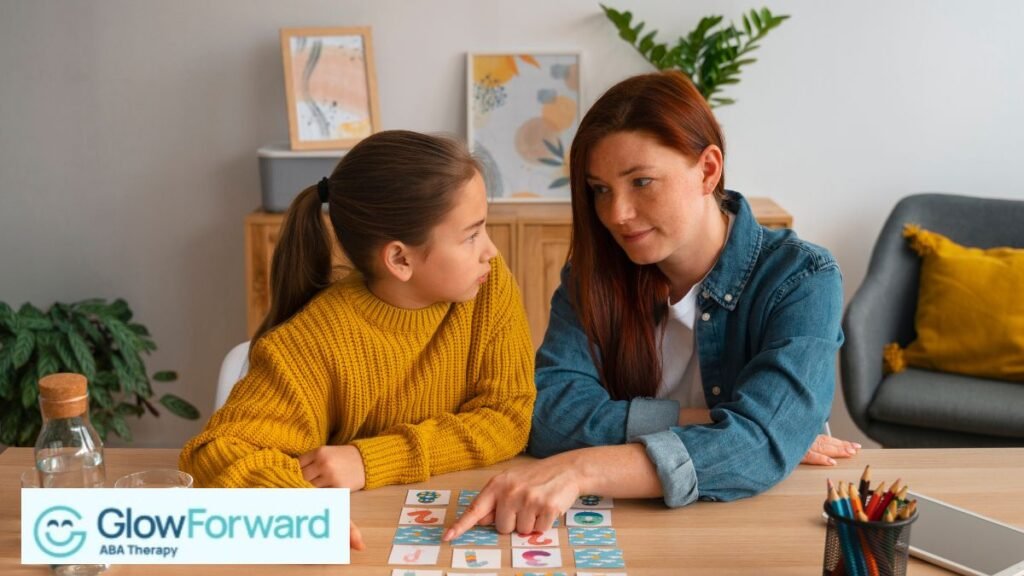
Therapy does not look like sitting at a desk completing worksheets. It is woven into the moments your child already lives through each day.
For example, a therapist might hold a container of bubbles and wait for your child to make a request, then immediately reward the attempt with praise and the bubbles themselves. That is Natural Environment Teaching (NET). Communication is reinforced in the moment it matters, not in a hypothetical exercise.
For self-care autism goals like brushing teeth, a therapist breaks the task into small steps, picks up the toothbrush, applies toothpaste, brushes for two minutes, and uses prompts to guide your child through each one. Prompts are faded as independence builds. The goal is always for your child to learn the skill.
When challenging behavior comes up during an activity, therapists do not respond with frustration or punishment. They analyze what is driving the behavior and redirect in a way that teaches an alternative. A child who throws a toy out of frustration might be guided to use a break card instead. That is independence training in a way that serves your child across every environment.
Home-based ABA therapy also builds confidence for caregivers. Life skills therapy only holds if parents and caregivers know how to support progress between sessions. Glow Forward actively coaches families throughout, so you feel supported and less overwhelmed.
How to Bring ABA Therapy into Your Home With Glow Forward ABA
Getting started with Glow Forward ABA is straightforward. Here is what our process looks like:
Reach Out: Contact our team to share a bit about your child and your goals. Insurance coverage and location are confirmed upfront.
Initial Assessment: A BCBA conducts an in-home evaluation, looking at your child’s strengths, current daily routines, and areas for growth.
Custom Program Design: Your BCBA builds a plan targeting your child’s specific goals. Communication, daily routine skill building, independence training, and social development are all considered.
Therapy Begins at Home: Your assigned therapist starts sessions in your home. The plan is structured but stays flexible as your child progresses.
Ongoing Progress and Family Coaching: Progress is reviewed regularly. Goals are updated when needed. Caregivers are coached throughout, so everyone stays informed and confident.
Contact us today to take the first step toward building independence, confidence, and daily living skills your child will carry with them for life.
Call us: +1 (888)-943-4684 or email us: Hello@glowforwardaba.com.

Frequently Asked Questions
1. How is in-home ABA therapy different from clinic-based therapy?
In-home ABA therapy happens in your child’s natural environment. Skills learned at home carry over into daily life far more effectively than skills practiced in a clinic setting. Home-based ABA therapy supports behavior generalization, which means your child practices communication, social skills, and ABA daily living skills exactly where they need them most.
2. How old does my child need to be to start?
Early intervention consistently produces the strongest long-term outcomes. Glow Forward works with children of various ages throughout North Carolina. The earlier therapy begins, the better the foundation your child builds. Reach out to the team to find out whether your child is a good fit.
3. What does a typical session look like?
Every session is built around your child’s individual goals and existing routines. Therapists work through structured activities, play, and natural everyday moments to target communication, social development, self-care, and behavioral goals. Sessions are always tailored to your child.
4. Do I need to be home during sessions?
Yes. A parent or caregiver must be present during in-home ABA therapy sessions. Your involvement is part of the process. Glow Forward coaches caregivers actively throughout, so you feel prepared to support your child’s progress every day, not just during sessions.
5. How many hours per week does in-home ABA therapy require?
Recommended hours depend on your child’s individual needs and therapy goals. BCBAs assess each child and design a program with the right intensity for meaningful, lasting progress. Scheduling is built to work with your family, not against it.